
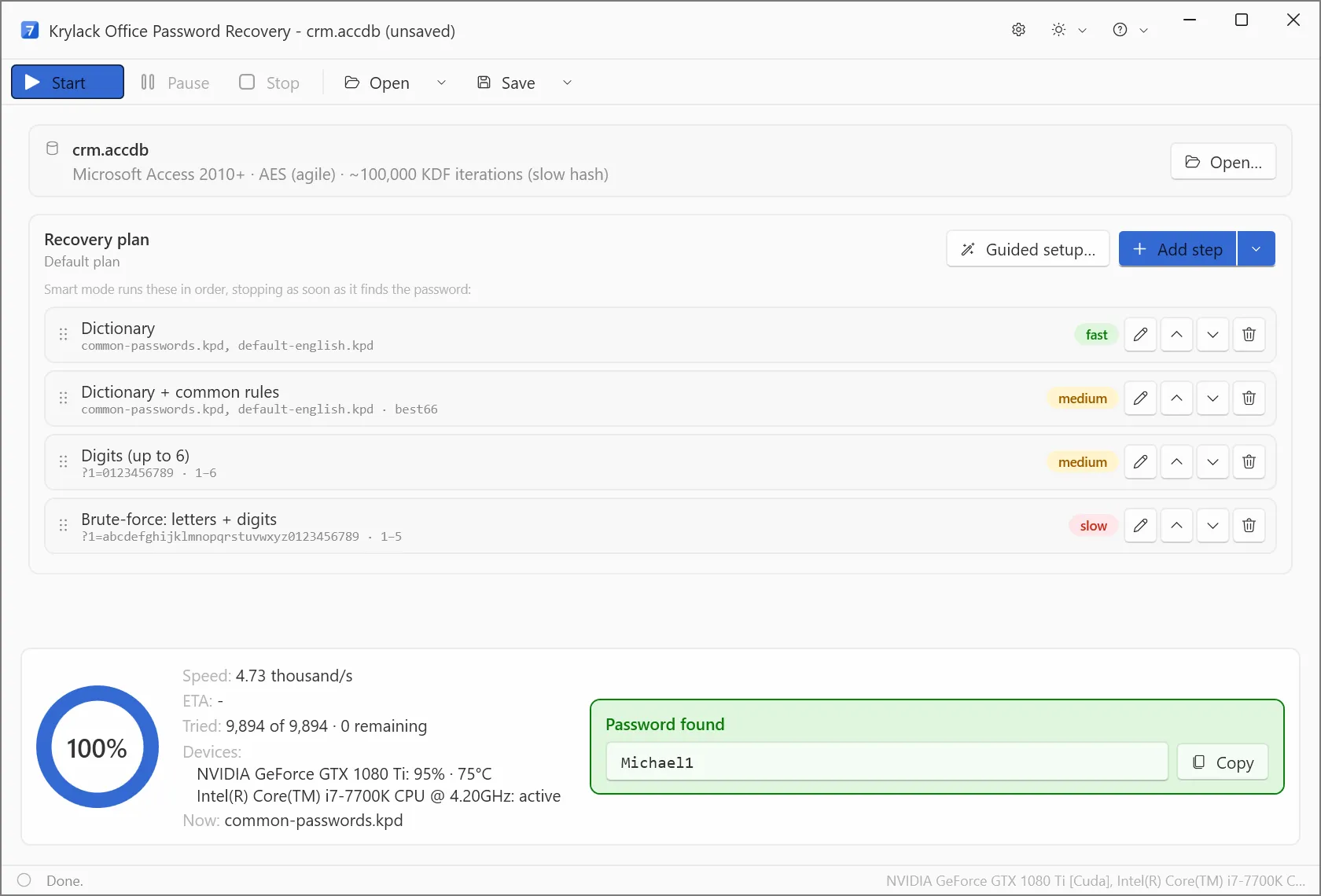
Covers Word, Excel, PowerPoint and Access
One edition handles every major Microsoft Office format, including Access databases, so whichever Office file you're locked out of, you're in the right place.
How Office password protection works
Microsoft changed Office encryption substantially over the years, and the version your file was saved in is the biggest factor in how quickly its open password can be recovered:
- Office 97-2003 (
.doc,.xls,.ppt): older RC4 / 40-bit encryption. Weak by modern standards, so recovery is comparatively fast. - Office 2007 (
.docx,.xlsx,.pptx): AES-128. Stronger, but still reasonable to search. - Office 2010: AES-128 with a heavier key-derivation step.
- Office 2013, 2016, 2019 and Microsoft 365: "agile" encryption with AES-256 and roughly 100,000 hashing iterations per guess. Deliberately slow, so strong passwords take far longer and a GPU makes a real difference.
Access is included, with its own quirks: a legacy .mdb database (Access 97-2003) stores its password with
simple obfuscation rather than real encryption, so it's recovered almost instantly; a modern .accdb (Access
2010+) uses the same agile AES-256 as recent Office.
What to expect
It always tries the most likely candidates first, so short and human-chosen passwords are very recoverable across every version.
- Older documents and legacy Access are recovered quickly, often almost instantly.
- 2013-and-newer documents use slow agile AES-256, so this is where GPU acceleration and the Smart and dictionary methods pay off, testing far more candidates each second.
A long, random password on the modern agile-AES format still gets everything the app can bring to bear.
Recovery methods
- Dictionary: real words and known password lists, with optional rules for how people modify passwords.
- Smart: masks and patterns for what you remember, such as length, a prefix, or a trailing year.
- Brute-force: every combination, best suited to short passwords.
Frequently asked
How do I open a Word, Excel or PowerPoint file I am locked out of?
Open the file in the app, choose a recovery method, and let it search for the document's open password. Once found, you use it to open the file normally.
Which Office version is my file?
The app detects it for you. As a guide, the .doc, .xls and .ppt files are the older and faster format, while .docx, .xlsx and .pptx are 2007 and later, with 2013 and newer being the slow, strongest kind.
Is Access covered?
Yes, both legacy .mdb and modern .accdb. Legacy Access passwords are typically recovered almost instantly.
My document opens but will not let me edit it.
That is a separate restrict-editing or worksheet-protection setting, which is different from the password that encrypts the file. This edition focuses on recovering the document's open password.